
Formes

Help me and I'll learn,
Challenge me and I'll grow,
Believe in me and the world will become my playground

Educational program

HighScope


The HighScope educational program is research-based. Its core principles are active learning, democratic adult-child interactions, and a learning environment where children can make choices and manipulate materials. The HighScope program values ​​children’s engagement in their play and community, all within a stable and secure daily routine and in partnership with adults.

Multi-age


“If I differ from you, far from harming you, I will actually enhance you.”

(Antoine de Saint-Exupéry)

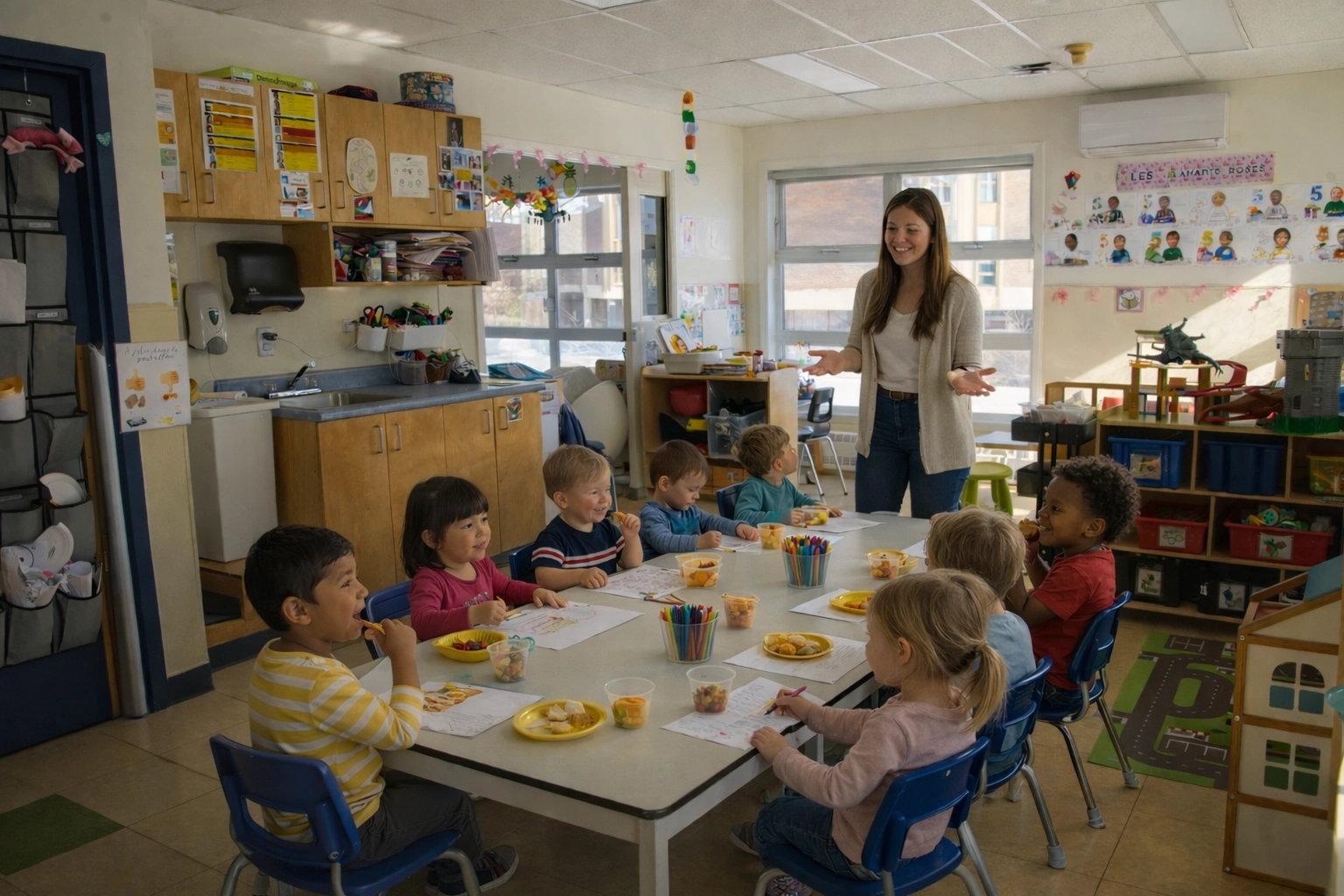
The multi-age approach is very old and has the advantage of being based on the family unit. It is defined as a combination of children of varying ages with different levels of development, cultural backgrounds, personalities, and interests. Thus, each child has their place, each child has something to offer the others, each child progresses at their own pace, and each child has the opportunity to be who they truly are.

The multi-age group provides an important educational environment that promotes:

  • The notion of sharing
  • Mutual aid and collaboration
  • Respect for differences
  • Offers siblings the opportunity to experience everyday life together
  • Children feel less competitive
  • Children exhibit fewer aggressive behaviors
  • Children are made aware of their social responsibilities at a fairly young age.

The advantages:

In a multi-age setting, children remain in the same group for several years, and this consistency in attendance leads to a stability that helps limit undesirable behaviors, facilitates better communication with the family, and promotes the creation of a strong attachment bond that allows the child to feel safe and freely explore their environment for proper development.

School transition


“The start of the school year is the threshold of all discoveries; every new beginning is a chance to grow, learn, and reinvent oneself.”

(Taha-Hassine Ferhat)

A school transition is a significant period of change for a child. Our mission is therefore to implement strategies to support the child, as well as the family, through this major transition to make it as smooth as possible.

  • Information sharing: Parents receive their child’s educational report electronically twice a year (December and June). These observational profiles are shared with the school to support a smooth transition, subject to parental consent.
  • Diverse learning activities (writing and math corner, shared reading, social story workshops, waiting your turn to speak, etc.).
  • Autonomy and healthy emotional management are principles instilled from the nursery.
  • Collaboration with external professionals for a child with special needs in order to help him acquire as much knowledge as possible before starting school and to be able to pass on winning strategies to his learning.
  • Implementation of task and responsibility charts for autonomy, conflict resolution steps, materials promoting early literacy, routines including a beginning, a process and an end, rules of life promoting respect for oneself, others and the environment, etc.
  • A special ritual is highlighted: graduation parties where parents are invited to attend a show prepared by the children, complete with surprises and lots of fun 🙂

Parent involvement


Little Bees Program

“Parents are the seed of the child and the soil in which he grows.”

(Martin Gray)

That is why parents are invited to share in the children’s daily life in the environment throughout the year, through the activities offered.

  • Read a story
  • To lead a discussion on a particular topic
  • Present your job
  • Share a special snack
  • Participate in a DIY project
  • Participate in a yoga session
  • Participate in planting our garden or flowers
  • Submit their winning recipe for our in-house recipe book
  • Etc.

Food

For us, instilling in children the basic principles of a healthy and balanced diet is of great importance, as it has a significant impact on their overall development. Our menus are therefore based on a variety of foods to encourage the discovery of tastes and flavors, on offering fresh fruits and vegetables (mostly locally sourced), on whole grains, and on proteins (half plant-based and half animal-based).

Our meals are lovingly prepared on-site by our food service staff, who carefully limit processed foods, sodium, and added sugars in the recipes. Every new child joining the daycare receives a complimentary bottle of water from the daycare so they can drink whenever they want.

“The secret to living well: eat half as much, walk twice as much, laugh three times as much, and love without measure.”

(Tibetan proverb)

Library

A child who is developing has every right to dream about who they want to become. That’s why we’ve created a space where children can explore, imagine, create, develop a love of learning, and above all, enjoy discovering new things. Reading to a child is a playful and informal introduction to the written word and phonological awareness, well before they start school.

In each of our facilities, to encourage a love of reading, we’ve provided families with a book exchange. The principle is simple: “Take a book or give a book”—it couldn’t be easier. Because a good book is meant to be enjoyed more than once.

“Reading is dreaming with your eyes open.”

(Kerry Reichs)

Inclusion of children with disabilities

Here, we guarantee the right to education and equality for every child by promoting respect, acceptance, sharing and inclusion.

“The diversity of each individual makes the wealth of all.”

(Julos Beaucarne)

Communication

  • Administrative communications are made using the Dokmail program
  • The child’s daily communications are transmitted via the communication notebook Petits Pas
  • Educational communications between parents and staff members are possible at any time, as needed, following a request.

“Every human group draws its strength from communication, mutual support and solidarity aimed at a common goal: the fulfillment of each individual while respecting differences.”

(Françoise Dolto)